

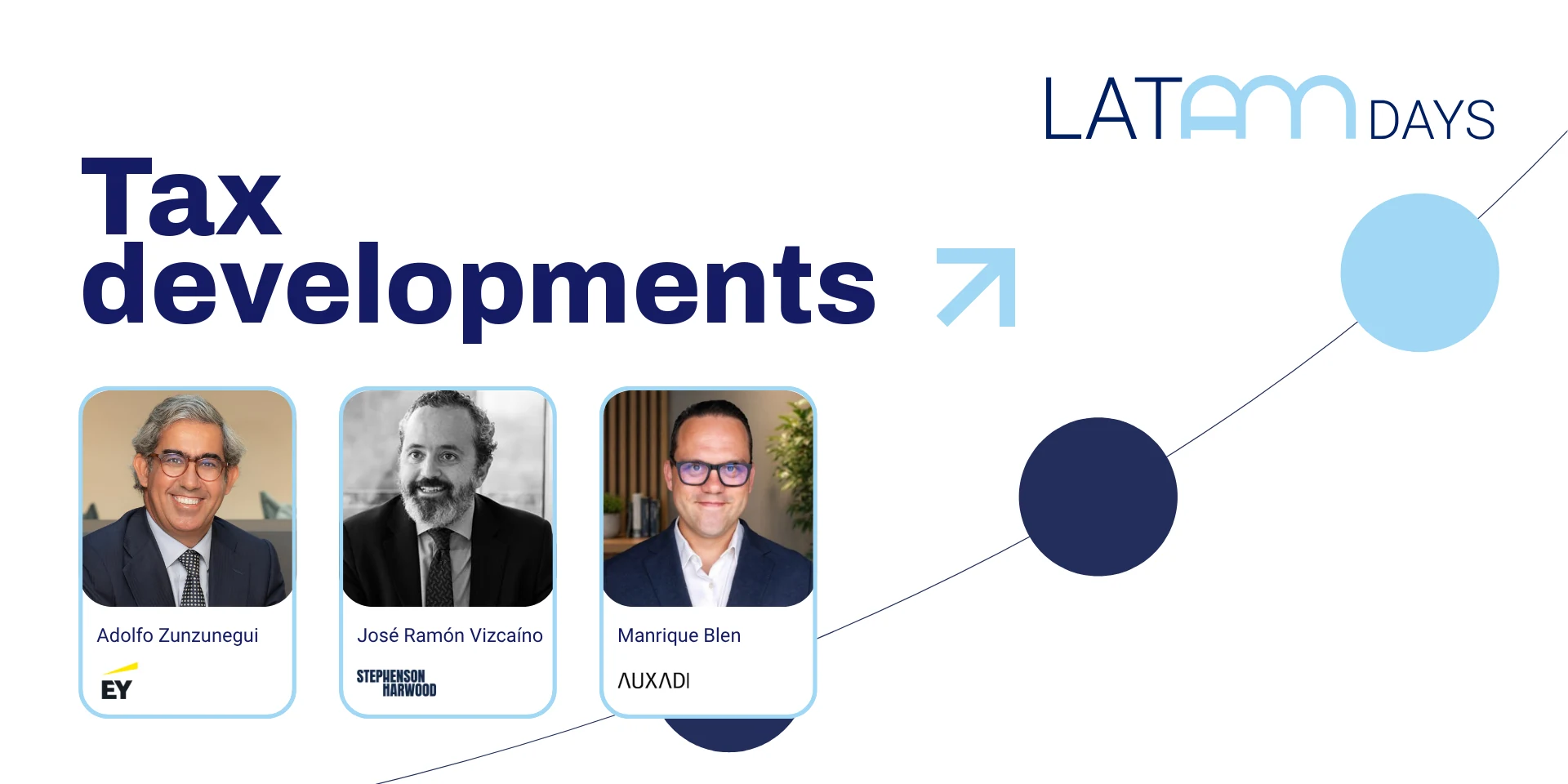

Tax developments in LATAM: trends and risks for international companies
This panel examined how taxation in Latin America is evolving amid political change, revenue needs and growing pressure from tax authorities.
Adolfo Zunzunegui, José Ramón Vizcaíno and Manrique Blen discussed the region’s main tax trends and the challenges international companies face in adapting to a more digital, immediate and demanding environment.

The starting point: more digital, demanding, data-driven taxation
Taxation in Latin America is moving towards a model of greater control, in which tax authorities have more information, better analytical tools and a greater ability to detect inconsistencies.
The panel stressed that change does not always come from major legislative reforms, but from a more intensive, coordinated and digital application of existing rules.
Discover more from LATAM Madrid 2026
How taxation is evolving in Latin America
The region is not always undergoing major legislative reforms. In many cases, the main change lies in how tax authorities interpret, apply and enforce existing rules.
This means companies may face new requirements even when legislation has not changed substantially. Tax enforcement is becoming more intensive, coordinated and data-driven.
Tax authorities are strengthening their control mechanisms to improve revenue collection and detect possible non-compliance.
Digital tax enforcement and real-time data
One of the main tax trends in LATAM is the digitalisation of tax control processes.
Authorities increasingly use e-invoicing, automatic data cross-checks and real-time data to identify discrepancies, unusual transactions or potential tax risks.
E-invoicing gives authorities almost immediate access to detailed information on companies’ transactions. This level of traceability enables faster, more accurate and more comprehensive audits, reducing the room to correct errors once detected.
Formal compliance is no longer enough
In a more digital and demanding tax environment, companies must show not only that they meet their obligations, but that their tax structure, actual operations and supporting documentation are consistent.
Mexico, Brazil and Chile as benchmarks in tax digitalisation
Mexico, Brazil and Chile were highlighted as countries that have made significant progress in using digital tools for tax control.
Companies operating in these markets need systems that can ensure the quality, consistency and traceability of tax information.
Economic substance as a tax priority
Tax authorities are paying increasing attention to the economic substance of corporate structures.
Having a legal entity or a contractual structure is no longer enough. Companies must show real functions, decision-making capacity, employees, genuine activity and value creation in the country.

Consistency between legal structure and actual activity
A corporate structure must reflect how the business actually operates. When legal form and economic activity diverge, tax risks and challenges from the authorities can arise.
Substance must be demonstrable through documentation, resources, staff and decision-making processes.
Application of OECD standards and anti-abuse rules
The demand for economic substance is linked to a more rigorous application of OECD standards.
Authorities are tightening control over tax treaties, beneficial ownership, anti-abuse rules and transfer pricing.

Closer scrutiny of intercompany payments and services
Intercompany services, management fees, royalties and other cross-border payments are under increasing tax scrutiny.
Authorities require companies to show that services were actually provided, deliver an economic benefit and that their cost is properly justified.
How to justify intragroup services
Companies must keep documentation evidencing the nature of the service, its performance, the value generated and the criteria used to set the price.
Insufficient evidence may lead to the expense being disallowed or to tax adjustments.
Transfer pricing and cross-border payments
Transfer pricing remains one of the highest-risk areas for international groups.
Transactions between related entities must reflect market conditions and be supported by documentation consistent with operational reality.
The tax landscape varies significantly across Latin American countries, so companies should avoid applying a single regional strategy.
Each market has its own processes, administrative criteria and enforcement priorities.
Main tax risks for international companies
Companies operating in Latin America face an environment of greater control and less tolerance for inconsistencies.
To reduce risk, companies should take a preventive approach and regularly review their tax and operating model.
Taxation in Latin America is moving towards a more digital, immediate and demanding model. Tax authorities have more information, better analytical tools and a greater ability to detect inconsistencies.
In this context, formal compliance is no longer enough. Companies must demonstrate economic substance, traceability, consistency between their operations and their tax position, and proper justification of their cross-border transactions.
Preventive planning, country-by-country analysis and specialist advice will be essential to reduce risk and operate securely in the region.
FAQs on taxation in LATAM








Auxadi and its commitment to internationalisation
Auxadi, a leading Spanish firm providing accounting services to multinationals and real estate funds, promotes LATAM Days as part of its commitment to business internationalisation. With an international presence and expertise in accounting, tax, payroll, transfer pricing and corporate legal services, it supports companies’ global growth through technology, local knowledge and strategic vision.

