

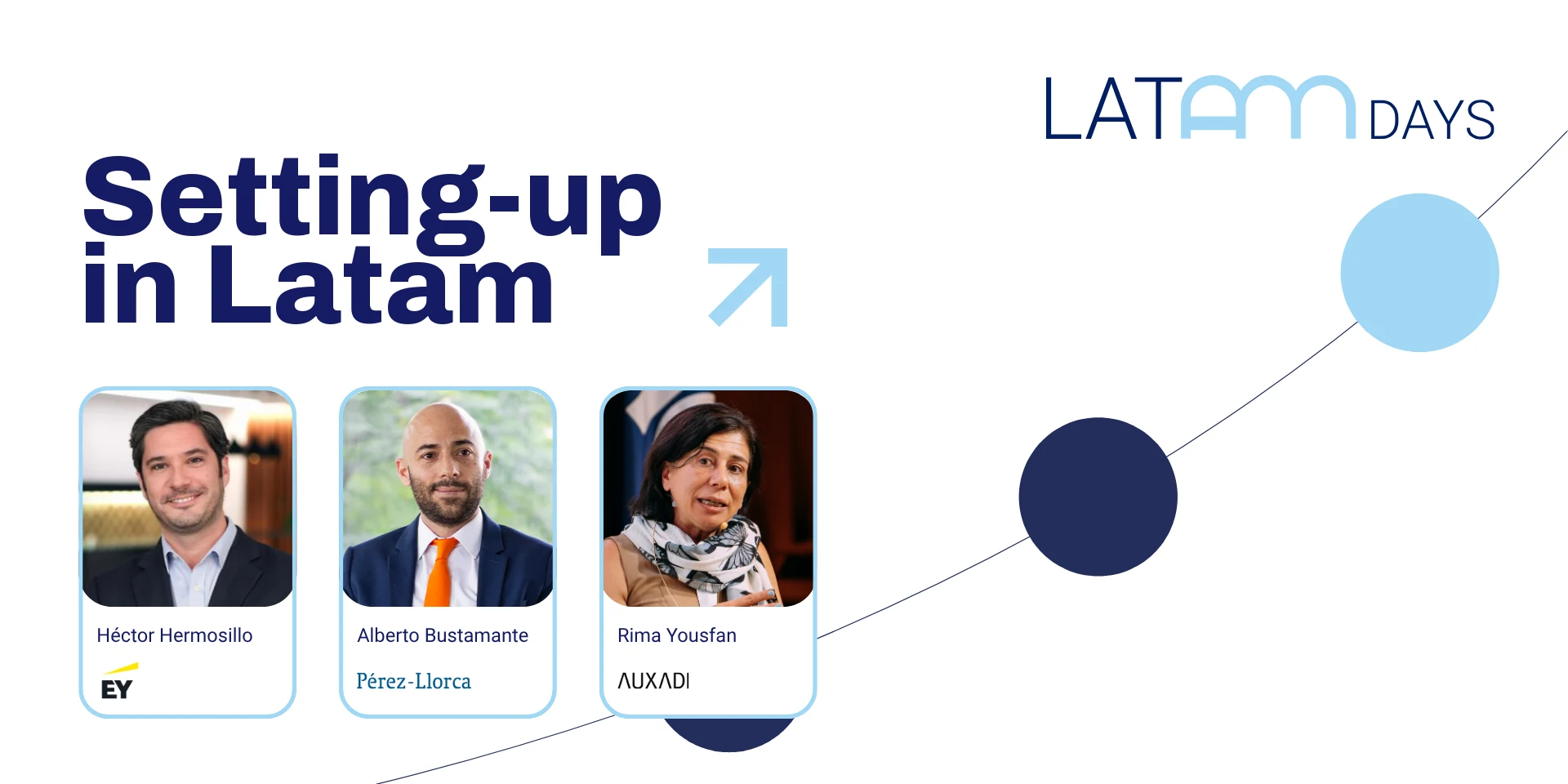
Setting up in LATAM: EOR, branch or subsidiary
This panel discussion looked at how companies should plan their set-up in Latin America from a legal, tax, employment and operational perspective.
During the session, Rima Yousfan, Alberto Bustamante and Héctor Hermosillo examined the main structures available for entering the region, the risks involved and the most common mistakes.

The starting point: choosing the right structure to operate in LATAM
Setting up in Latin America takes far more than picking a quick route to start operating. Every company needs to analyse its business model, the level of presence it wants in the country and the legal, tax, employment and operational implications of each structure.
In this panel discussion, the debate focused on how to choose between an EOR, a branch and a subsidiary, and on the importance of taking that decision with a long-term view in order to reduce risks and avoid costs down the line.
Latin America is not a homogeneous market
Although cultural and linguistic affinities exist, each Latin American country has its own procedures, timeframes, tax requirements and ways of operating.
Incorporating a company in Mexico, Colombia or Peru can involve very different processes. A structure that works in one country should therefore not be applied automatically in another without first analysing its regulations and operating conditions.
- Different procedures from country to country
- Specific timeframes and tax requirements
- Local operating conditions
- The need to analyse each market individually
An option for the early stages
An Employer of Record, or EOR, can be useful when a company wants to explore a market, carry out commercial prospecting or hire a local employee without yet setting up an entity of its own.
How to choose between an EOR, a branch and a subsidiary
The legal structure must be aligned with the actual business model and with the level of presence the company wants in the country.
Before choosing between an EOR, a branch and a subsidiary, it is necessary to look at the expected duration of the activity, employee hiring, signing contracts locally, invoicing capacity, the existence of assets or servers, the volume of commercial operations, financing needs and the future repatriation of profits.
The decision should not be based solely on speed or initial cost, but also on medium- and long-term growth objectives. So what should a company look at?
A fast structure is not always the right structure
Entering a market quickly may be necessary, but doing so without planning can prove expensive.
A successful set-up in Latin America means choosing a structure that matches the company’s real activity and its growth objectives.
Key tax, legal and employment risks
A poorly structured set-up can generate unforeseen costs, penalties and additional obligations.
The main risks include inadvertently creating a permanent establishment, breaching employment law, insufficient tax planning, or choosing a structure that does not reflect the activity actually carried out in the country.
Transfer pricing, VAT, other indirect taxes, payroll management and the mechanisms for repatriating profits must also be considered.
Common mistakes when setting up a company in LATAM
The panel highlighted a number of common mistakes that can have a direct impact on setting up a company in Latin America.

- Using standard contracts.
Applying contracts without adapting them to local regulations can create legal and employment risks. - Operating without a defined legal model.
Starting to operate without a clear structure can lead to unforeseen obligations. - Assuming LATAM works the same way in every country
The same structure will not necessarily work for Mexico, Colombia, Peru or other markets in the region. - Failing to plan for tax
Overlooking transfer pricing, VAT, other indirect taxes or the repatriation of profits can generate additional costs. - Keeping an EOR longer than necessary
Once the activity calls for a structure of its own, continuing with an EOR can increase risk.
Keys to a secure set-up in Latin America
Entry into a new country should be approached through a roadmap that brings together the legal, tax, employment, financial and operational areas.
Every company should study its business model, the level of presence it wants to reach and the particularities of the destination market. Specialist advice makes it possible to adapt the structure, anticipate risks and stop a quick fix from generating costs in the long run.
An EOR can be right for an initial stage, while a branch or a subsidiary may be more appropriate once the company’s presence is settled.
The decision has to be taken country by country, with a long-term view and bearing in mind the legal, tax, employment and operational aspects.
Planning the LATAM set-up properly reduces risks, avoids unforeseen costs and builds a structure aligned with the company’s growth objectives.
FAQs on setting up companies in Latin America

Auxadi and its commitment to internationalisation
Auxadi, the leading Spanish firm in accounting services for multinationals and real estate funds, drives LATAM Days as part of its commitment to business internationalisation. With an international footprint and expertise in accounting, tax, payroll, transfer pricing and corporate legal services, it supports companies in their global growth through technology, local knowledge and strategic vision.

