


Exchange rates and volatility: how to protect international business
The panel discussion on exchange rates and volatility in uncertain times analysed how to protect business value in an international environment shaped by currencies, geopolitical risks, inflation, interest rates and exchange rate volatility.
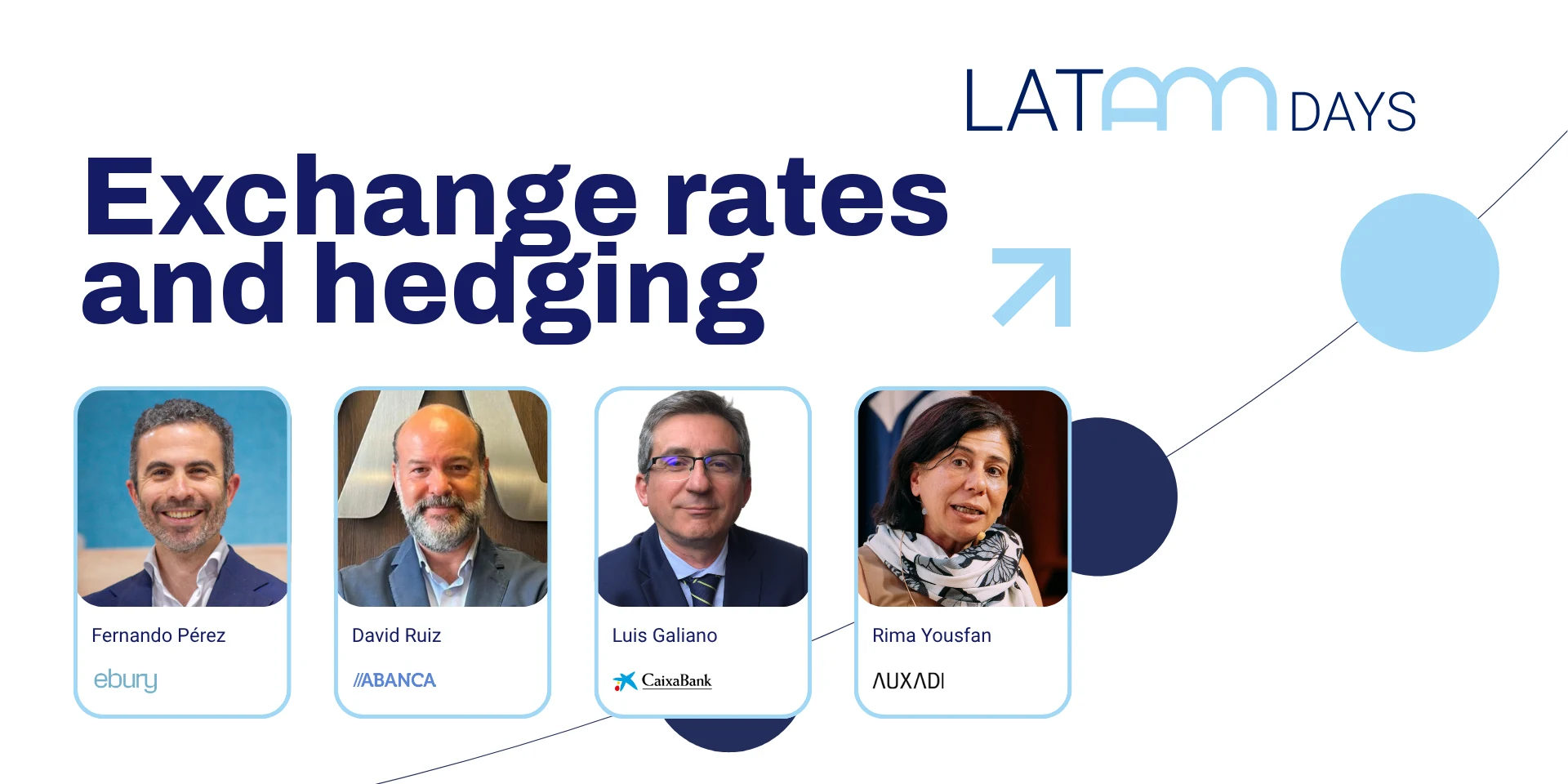
Fernando Pérez, David Ruiz, Luis Galiano and Rima Yousfan discussed the importance of managing currency risk proactively to protect margins, profitability and international operations.

The starting point: preserving value amid exchange rate volatility
Companies operating in Latin America must focus not only on creating value, but also on preserving it. When a company invests, invoices, pays costs, finances operations or repatriates dividends in different currencies, exchange rate fluctuations can directly affect its margins, profitability and income statement.
The panel stressed that exchange rate management should be part of the financial strategy from the outset, rather than being addressed only when a loss or a period of high volatility arises.
Discover more from LATAM Madrid 2026
How exchange rates affect international companies
Exchange rate fluctuations can change the value of an international company’s revenue, costs, financing and dividends.
This impact is especially relevant for importers, exporters and companies with a presence in Latin America, where exposure to different currencies can directly affect the profitability of their operations.
Main financial risks in international operations
Companies must consider various external risks related to commodities, energy, interest rates and currencies.
Impact of Latin American currency volatility
Importers, exporters and companies with a presence in Latin America can be affected by the volatility of the US dollar, Colombian peso, Argentine peso, Mexican peso, Brazilian real or Peruvian sol.
Poor management of these fluctuations can reduce margins and jeopardise the profitability of international operations.
Currency risk management should therefore be part of the financial strategy of companies with international activity, especially when they work across different markets, currencies and transaction timeframes.
Currency hedging is not a cost, but a tool to protect the business
Currency hedging protects margins, provides predictability and prevents volatility from jeopardising the profitability of an international investment or project.
Hedging policies to protect margins
Many companies only start to consider currency hedging after suffering a loss or seeing volatility erode their margins.
Instead of this reactive approach, it is advisable to design treasury and hedging policies tailored to the actual characteristics of each business.

How to analyse exposure to currency risk
Not all companies have the same level of exposure or need the same financial tools.
A company with tight margins may need a stricter hedging policy than one with wider profitability.
Understand the business, flows and currencies
The first step is to properly analyse the business model, financial flows, transaction timeframes and the currencies the company works with.
This understanding makes it possible to design a hedging strategy consistent with the actual activity and the level of risk taken on.
Currency management in Latin American investment in Spain
David Ruiz shared the perspective of private Latin American investors in Spain, especially in the Madrid real estate market.
Many high-net-worth Latin American investors are used to operating in several currencies and managing international structures.
Emotional and wealth factors in investment
In these transactions, decisions are not based solely on financial criteria. Family and wealth factors also come into play, such as housing, legal certainty, children’s education or the search for stability.

Banking fragmentation and international financial coordination
Companies operating in several countries may face different terms, contacts, platforms and financial policies, even within the same bank.
Global platforms and comprehensive advice
Managing this fragmentation requires coordinated financial structures, global platforms and comprehensive advice that provides a consolidated view of operations.
Keys to managing exchange rate volatility
Exchange rate management should be planned from the outset, not only when a loss or a period of high volatility arises.
Companies must analyse their exposure to different currencies, understand their flows and timeframes, design hedging policies tailored to the business and coordinate financial management across countries.
Currency hedging should not be seen as an unnecessary cost, but as a tool to protect margins, provide predictability and prevent volatility from jeopardising the profitability of an international investment or project.
Exchange rate management should be part of the financial strategy from the outset, adapted to each company’s level of exposure, flows, timeframes and currencies.
In an international environment marked by volatility, financial planning and specialist advice are key to protecting the business and making decisions with greater confidence.
FAQs on exchange rates and volatility





Auxadi and its commitment to internationalisation
Auxadi, a leading Spanish firm providing accounting services to multinationals and real estate funds, promotes LATAM Days as part of its commitment to business internationalisation. With an international presence and expertise in accounting, tax, payroll, transfer pricing and corporate legal services, it supports companies’ global growth through technology, local knowledge and strategic vision.

