


In practice, a significant portion of transfer pricing audit processes in Panama do not begin with complex structures. This situation starts with something much more basic: inconsistencies between what the company declares in its Sworn Declaration (DJR) and what it reports in Form 930.
Throughout recent years, we have seen how apparently minor differences -derived from accounting reclassifications, different recognition criteria, or simple currency conversion errors- have been sufficient to trigger formal requests for information, cross-checks, and, in some cases, relevant tax adjustments.
Therefore, the correct declaration of operations with related parties has ceased to be a merely formal exercise. Now, it has become a central element in the management of corporate tax risk in Panama.
DJR: much more than an annual obligation
The deadline for filing the Sworn Declaration (DJR) is March 30. In it, taxpayers must expressly report the amounts corresponding to operations carried out with related parties during the fiscal year.
In theory, it is just another section within the tax return. In practice, it is one of the first points the Tax Administration contrasts when analyzing a taxpayer’s risk profile. This document compiles:
- intragroup income;
- service expenses;
- royalties;
- financing and balances with affiliates are a habitual part of this preliminary review.
Form 930
In addition to the DJR, any resident entity that performs operations with related parties must file Form 930, the deadline for which ends on June 30.
Furthermore, it is worth emphasizing that there is no minimum threshold of operations to be exempt from this obligation.
In recent times, companies with simple structures have been seen assuming that, because the amounts were small, Form 930 was not relevant. The error usually materializes when the first notification from the DGI arrives.
The penalty for not filing or filing Form 930 past the deadline amounts to 1% of the total operations with related parties, with a limit of USD 1,000,000.
Economic studies: the point where the case is won or lost
From a technical point of view, the transfer pricing study fulfills two critical functions:
It allows for formal compliance with Form 930, which requires reporting the range of market values obtained from comparable independent companies.
It authorizes the evaluation of whether the policy applied by the company during the fiscal year is defensible under the arm’s length principle.
When results fall outside the range, a voluntary adjustment within the DJR is usually the least costly and most efficient option.
Waiting to correct via a supplementary declaration implies not only additional penalties (USD 500), but, above all, leaving traceability of an inconsistency that can be interpreted negatively in a subsequent inspection process.
Audits: the change is already structural
In recent fiscal years, the DGI has moved from performing specific reviews to implementing systematic consistency analyses between:
- the Sworn Declaration (DJR),
- Form 930,
- the economic studies presented or requested.
In practice, the lack of coherence between the DJR and Form 930 has become one of the main problems for the Panamanian Tax Administration. This phenomenon evidences possible errors in the determination of the tax or deviations regarding the arm’s length principle.
Cross-checks that should always be reviewed
Before presenting both declarations, it is prudent to validate at least the following points:
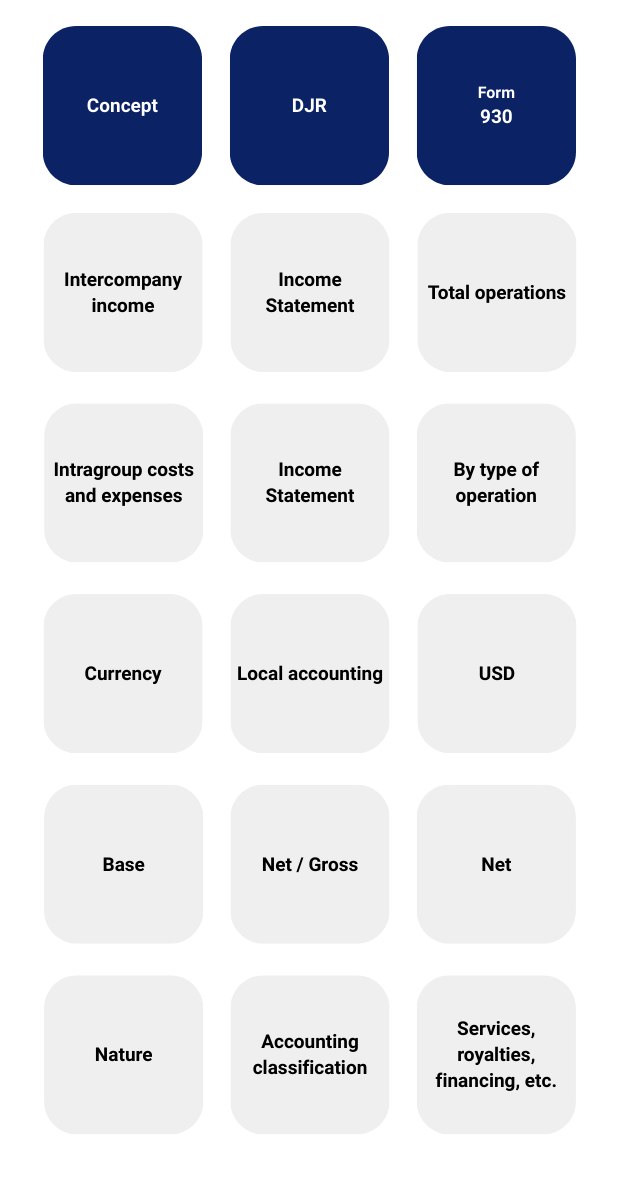
In many cases, the problem is not the price, but how it is reported.
The errors that cost the most
In recent processes, the following have been recurrently found:
- Correctly valued but misclassified operations.
- Form 930 with totals that do not reconcile with the financial statements.
- Reimbursements treated as services.
- Economic studies that do not match what was effectively declared.
- Lack of sufficient documentary support to explain the position within the range.
Any of these points, by itself, is sufficient to justify a formal requirement.
Conclusion
Today, in Panama, the risk in transfer pricing no longer resides solely in the method applied or the margin obtained. It resides, increasingly, in the coherence between what is declared, what is reported, and what is documented.
When those three pieces do not fit, the audit usually arrives. And when they coincide, the taxpayer is usually in a solid position to defend their policy before the Tax Administration.
How we manage this risk at Auxadi
At Auxadi, we approach transfer pricing compliance as an integrated process, not as three isolated obligations.
Our work usually includes:
- Preparation or updating of the economic study.
- Technical review of the DJR.
- Detailed validation of Form 930.
- Reconciliation of figures and types of operation.
- Advance identification of necessary adjustments.
In addition, we perform specific preventive consistency reviews of DJR–Form 930 before the tax deadlines, precisely to avoid preventable differences from becoming relevant contingencies.
Therefore, if you are interested in adopting a transfer pricing policy suited to international standards, do not hesitate to contact our experts to consult our services regarding transfer pricing.
At Auxadi, we offer comprehensive services in accounting, tax, payroll, transfer pricing and corporate legal services to multinationals and funds. With experience since 1979 and a presence in over 50 countries, including 26 proprietary subsidiaries, our advanced technological platform, MySPV, and proven methodology enable us to guarantee efficient management in compliance with local regulations.
Author:
Oriana García
Transfer Pricing Manager – PA
Can Auxadi help?
Auxadi can become your ideal partner. We offer a one stop shop value added outsourcing services in the areas of accounting and reporting, tax compliance, payroll management and representation services, among others.
Local Knowledge – International Coverage
Founded in 1979, Auxadi is a family-owned business working for multinational corporations, private equity funds and real estate funds. It’s the leading firm in international accounting, tax compliance, payroll, transfer pricing, and corporate legal services management connecting Europe and the Americas with the rest of the world, offering services in 50 countries. Its client list includes many of the top 100 PERE companies. Headquartered in Madrid, with offices in US and further 26 international subsidiaries, Auxadi serves 1,500+ SPVs across 50 jurisdictions.
All information contained in this publication is up to date on 2026. This content has been prepared for general guidance on matters of interest only, and does not constitute professional advice. You should not act upon the information contained in this chart without obtaining specific professional advice.No representation or warranty (express or implied) is given as to the accuracy or completeness of the information contained in this content, and, to the extent permitted by law, AUXADI does not accept or assume any liability, responsibility or duty of care for any consequences of you or anyone else acting, or refraining to act, in reliance on the information contained in this chart or for any decision based on it.